Bedside Lighting for a Small Room: Where the Lamp Should Work
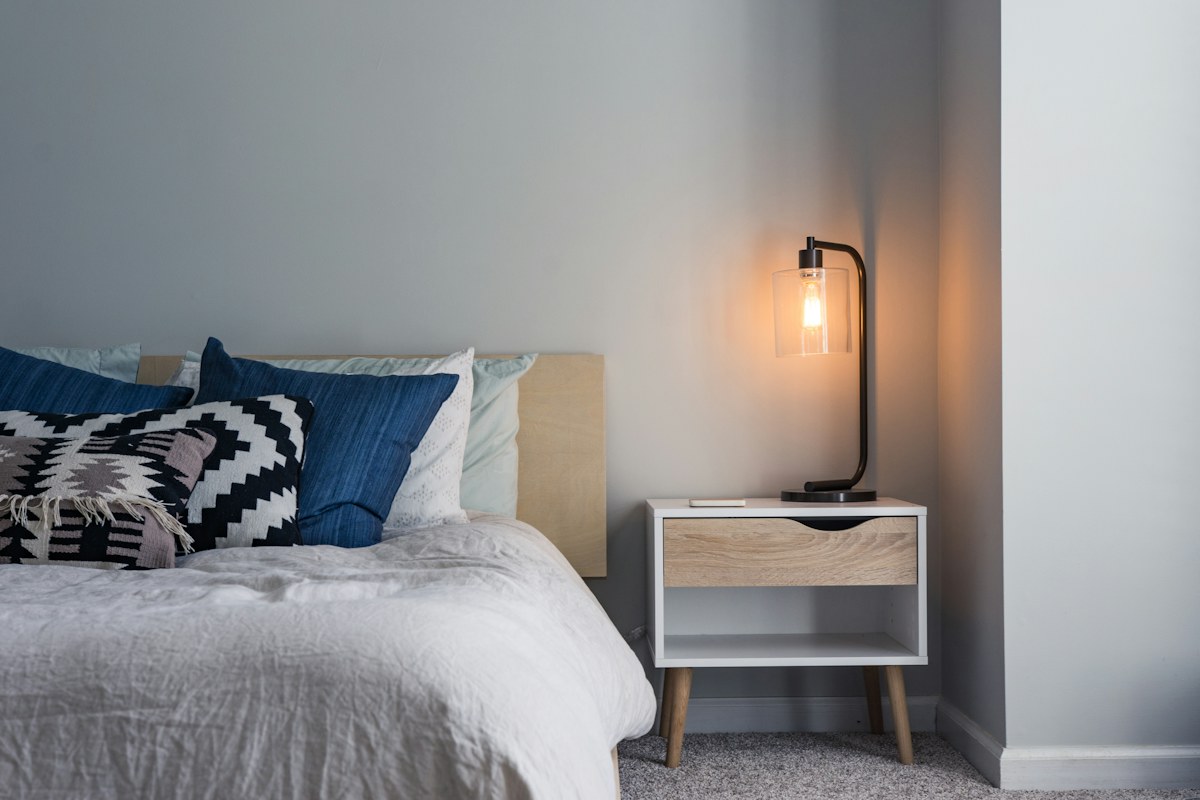
In a small bedroom, the lamp often shares its surface with a book, glasses, water and a phone. Choosing the narrowest base may recover a little space, but it does not guarantee comfortable light. Start with where you sit, what you need to see and how you will reach the switch once you are in bed.
Bedside lighting usually has two different jobs: helping you read or find things, and creating a quieter atmosphere than the main ceiling light. One lamp can sometimes do both, but the shade, position and controls matter as much as its appearance.
Check the view from the pillow
Sit in your usual reading position before measuring. Imagine the shade or light source at the proposed height. You should be able to illuminate the page without staring directly into a bright source. Someone lying beside you may have a different line of sight, so assess both positions.
Try an existing lamp temporarily if you have one. Move it safely within the limits of its cord and observe shadows on the book. A light placed behind your shoulder behaves differently from one low beside the mattress. This simple trial can prevent buying a beautiful lamp with the wrong geometry.
Keep lamps stable and cords arranged to avoid trips or trapping. Follow the manufacturer’s positioning and clearance instructions, especially around bedding and curtains. Do not cover a lamp to make its light softer.
Compare the formats
| Format | Best practical use | Check before buying | Tradeoff |
|---|---|---|---|
| Compact table lamp | Flexible placement | Shade width, base stability and switch reach | Uses bedside surface |
| Plug-in wall light | Recovering table space | Fixings, cable route and adjustability | Requires installation |
| Hardwired wall light | A planned permanent layout | Professional installation and switch position | Less flexible when moving furniture |
| Suitable clip-on light | A specific reading spot | Approved attachment surface and secure fit | May cast a narrow beam |
Choose the format before choosing the finish. A brass lamp does not solve an unreachable switch, and a wall light is not a space-saving success if its shade obstructs the route beside the bed.
Think about controls after dark
Reach from a normal resting position. A switch halfway down a cable may disappear behind the bedside table. A touch control can be convenient, but check how it works and whether its brightness steps suit you.
If considering dimming, verify compatibility across the lamp, bulb and control. Do not assume any dimmable bulb will work with any dimmer. Read the exact specifications rather than relying on a broad product category.
Smart controls can help some households, but they add setup and reliance on another system. Decide whether a simple physical switch is easier for daily use and for visitors. Convenience should remain available when a phone is not beside the bed.
Check bulb and shade details
Read the permitted bulb fitting, type and maximum rating. The bulb must suit the fixture and its instructions. When comparing light output, look at the stated lumens rather than treating electrical power as a direct brightness comparison between different technologies.
Colour appearance is another choice. A warmer-looking light may suit winding down, while a reading task still needs adequate visibility. The room’s wall colours and shade material influence the result, so a single specification does not describe the whole experience.
An opaque directional shade can help focus light, whereas a translucent shade spreads it more broadly. Neither is automatically better. Consider whether the lamp is mainly for reading or for lighting the room softly.
Make the surface work around the lamp
Measure the shade’s widest point, not just the base. Check drawer access and room for the things you genuinely use. A small wall shelf may suit a tight room, provided it is appropriately fixed and safely placed.
Give books and glasses simple destinations rather than adding several miniature organisers. The same principle used in layering a sofa applies here: decorative pieces should leave the furniture comfortable to use.
Frequently asked questions
Do both sides of the bed need matching lamps?
No. They can share a finish or shade shape while meeting different reading and space needs. Coordinate the overall effect without sacrificing comfort.
Can a wall light be installed without an electrician?
Some plug-in designs have straightforward mounting instructions, but hardwired electrical work needs an appropriately qualified person and compliance with local requirements. Follow the specific product guidance.
What should I measure first?
Your reachable switch position, the available shade space and the light’s relationship to your seated eye line. Those measurements narrow the useful choices quickly.